Are you wondering if Wifi 7 is really better than Wifi 6E? If you want faster speeds, stronger connections, and smoother streaming, this question matters to you.
Choosing the right Wifi can change how you work, play, and connect every day. Keep reading to discover what makes Wifi 7 stand out and whether it’s worth upgrading your current setup. This guide will help you make the best choice for your home or office network.
Wifi 7 Vs Wifi 6e: Key Differences
WiFi 7 and WiFi 6E are the latest wireless standards. They offer faster speeds and better connections. Understanding their differences helps choose the right option for your needs.
This comparison focuses on frequency bands, speed, latency, and device support. These areas show how each technology improves wireless networking.
Frequency Bands And Channels
WiFi 6E uses three main frequency bands: 2.4 GHz, 5 GHz, and 6 GHz. The 6 GHz band adds more channels and less interference. WiFi 7 keeps these bands but adds new features.
- WiFi 6E supports up to 160 MHz channel width.
- WiFi 7 supports up to 320 MHz channel width.
- WiFi 7 introduces Multi-Link Operation for using multiple bands simultaneously.
- WiFi 7 has more flexible channel use to reduce congestion.
Speed Enhancements
WiFi 7 offers faster speeds than WiFi 6E. It uses advanced technologies to boost data rates and efficiency. This helps with streaming, gaming, and large file transfers.
| Technology | Max Speed |
| WiFi 6E | Up to 9.6 Gbps |
| WiFi 7 | Up to 46 Gbps |
Latency Improvements
Lower latency means quicker responses on your devices. WiFi 7 reduces latency by using better scheduling and Multi-Link Operation. This is useful for video calls and online gaming.
WiFi 6E also lowers latency compared to older standards but does not have the same multi-band simultaneous use that WiFi 7 offers.
Compatibility And Device Support
WiFi 6E devices are widely available now. They support the new 6 GHz band and older bands. WiFi 7 devices are just entering the market and will support all WiFi 6E bands plus improvements.
- WiFi 6E works with existing WiFi 6 devices.
- WiFi 7 is backward compatible with WiFi 6 and 6E devices.
- WiFi 7 devices will require new hardware due to advanced features.
- Adoption of WiFi 7 will grow as more devices support it.
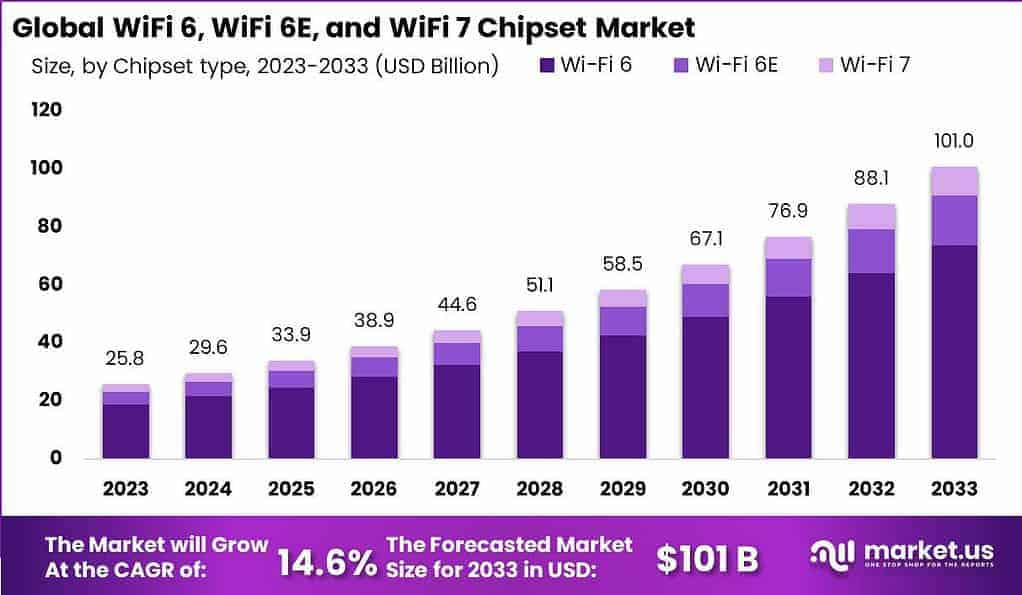
Credit: market.us
Speed Comparison
Wifi 7 and Wifi 6E are the latest wireless standards. They both promise faster speeds. Let’s see how they compare in real use.
This comparison looks at maximum throughput, real-world performance, and their effect on streaming and gaming.
Maximum Throughput
Wifi 7 supports higher data rates than Wifi 6E. It uses wider channels and better technology. This allows more data to move at once.
| Feature | Wifi 6E | Wifi 7 |
| Max Speed | 9.6 Gbps | 46 Gbps |
| Channel Width | Up to 160 MHz | Up to 320 MHz |
| Modulation | 1024-QAM | 4096-QAM |
Real-world Performance
Actual speeds depend on many factors like walls, devices, and interference. Wifi 7 often delivers faster speeds in close range. It also handles many devices better.
- Wifi 7 reduces delays with multi-link operation
- It uses improved error correction for stability
- Wifi 7 supports more simultaneous streams
Impact On Streaming And Gaming
Streaming and gaming need steady, fast connections. Wifi 7 lowers lag and buffering. It supports higher resolution streams and smoother gameplay.
- Reduced latency for gaming
- Better handling of 4K and 8K video streams
- More reliable connections in crowded networks
- Faster data rates for quick downloads
Performance Factors
WiFi 7 and WiFi 6E are new wireless standards that aim to improve internet speed and quality. Both have features that affect how well your devices connect and stay online.
This section looks at key performance factors to help you understand the differences between WiFi 7 and WiFi 6E.
Signal Range And Stability
WiFi 7 offers better signal range and stability than WiFi 6E. It uses wider channels and advanced antenna technology. This helps signals travel further and stay strong even in busy places.
WiFi 6E improves on WiFi 6 by adding the 6 GHz band. This band has less crowding but shorter range. WiFi 7 uses smarter ways to keep the signal stable across all bands.
Interference Management
WiFi 7 manages interference better than WiFi 6E. It can handle more signals at once and avoid clashing with other devices. This means fewer dropped connections and smoother data flow.
- WiFi 7 uses Multi-Link Operation to connect on different bands simultaneously.
- It supports wider channels to reduce interference.
- Advanced beamforming helps focus signals to devices.
- WiFi 6E reduces interference by using the new 6 GHz band.
Multi-user Capabilities
WiFi 7 improves multi-user support with better data sharing and lower latency. It allows more devices to connect without slowing down the network.
| Feature | WiFi 6E | WiFi 7 |
| Maximum Spatial Streams | 8 | 16 |
| OFDMA Support | Yes | Enhanced |
| Multi-Link Operation | No | Yes |
| Latency | Low | Lower |
Technical Innovations
Wifi 7 offers new technical features that improve wireless networks. It builds on Wifi 6E’s strengths and adds new ways to boost speed and efficiency.
Understanding these innovations helps see how Wifi 7 might perform better in real use.
Multi-link Operation
Wifi 7 introduces Multi-Link Operation (MLO). MLO lets devices connect using multiple frequency bands at once.
This means devices can send and receive data on different bands like 2.4 GHz, 5 GHz, and 6 GHz simultaneously. It reduces delays and improves network stability.
- Combines several channels for faster data transfer
- Switches between bands to avoid interference
- Improves connection reliability
Enhanced Modulation Techniques
Wifi 7 uses higher order modulation called 4096-QAM. This encodes more data in each signal wave than Wifi 6E’s 1024-QAM.
This change allows Wifi 7 to carry more information in the same time. It helps increase maximum speeds and network capacity.
- 4096-QAM sends 4 times more data per symbol than 1024-QAM
- Needs stronger signal quality for best results
- Boosts peak throughput on compatible devices
Improved Channel Utilization
Wifi 7 supports wider channels up to 320 MHz. It also uses better channel management techniques.
These improvements let Wifi 7 use airwaves more efficiently. It reduces wasted space and lowers signal interference.
- 320 MHz channels double the width of Wifi 6E’s 160 MHz
- Dynamic channel selection avoids busy frequencies
- Better use of available spectrum for faster speeds
Use Cases And Practical Benefits
Wifi 7 offers faster speeds and lower latency than Wifi 6E. This makes it useful for many real-life situations.
We will look at how Wifi 7 improves smart homes, business networks, and public WiFi spots.
Smart Homes And Iot
Smart homes use many connected devices like cameras, lights, and sensors. Wifi 7 supports more devices with less delay.
- Connect many IoT devices smoothly
- Stream high-quality video on multiple devices
- Improve smart security system response times
- Enable faster voice assistant commands
Enterprise Networks
Companies need fast and reliable WiFi for many users and devices. Wifi 7 helps handle heavy network traffic better than Wifi 6E.
| Feature | Wifi 6E | Wifi 7 |
| Maximum Speed | Up to 9.6 Gbps | Up to 46 Gbps |
| Latency | Low | Lower |
| Device Capacity | High | Much Higher |
| Frequency Bands | 2.4, 5, 6 GHz | 2.4, 5, 6, 7 GHz |
Public Wifi Environments
Public WiFi spots like cafes and airports have many users. Wifi 7 can manage many connections better and reduce slowdowns.
Benefits of Wifi 7 in public WiFi:
- Faster internet for everyone
- Less lag during video calls and streaming
- Better support for crowded areas
- Improved security features
Credit: bizaar.ai
Future-proofing Your Network
WiFi technology is evolving fast. WiFi 7 and WiFi 6E are the latest options. Understanding these can help keep your network ready for the future.
Choosing the right WiFi can save you time and money. It’s important to know how each one fits your needs.
Device Availability And Adoption
WiFi 6E is becoming common in new devices. Many smartphones and laptops support it now. WiFi 7 is still new, so few devices use it yet.
Check your current devices before upgrading. Make sure they can use the new WiFi version. This will help you decide if an upgrade is needed.
- WiFi 6E: Widely available in 2023
- WiFi 7: Limited device availability
Cost Considerations
Upgrading to WiFi 7 might be costly. New routers and devices are expensive. WiFi 6E is cheaper because it has been around longer.
Think about your budget before choosing. If cost is a concern, WiFi 6E might be the better choice now.
| WiFi 6E | Lower cost |
| WiFi 7 | Higher cost |
Upgrade Recommendations
Upgrading depends on your needs. If you need faster speeds now, consider WiFi 6E. If you can wait for more devices, WiFi 7 is worth considering.
Plan your upgrade based on device support and budget. This will help you make the best choice for your network’s future.
- WiFi 6E: Good for immediate upgrades
- WiFi 7: Consider for long-term plans

Credit: www.reddit.com
Frequently Asked Questions
What Are The Main Improvements Of Wifi 7 Over Wifi 6e?
WiFi 7 offers higher speeds up to 46 Gbps, lower latency, and better multi-device performance. It also uses wider channels and improved modulation for faster data transfer than WiFi 6E.
Is Wifi 7 Backward Compatible With Wifi 6e Devices?
Yes, WiFi 7 is backward compatible with WiFi 6E and earlier WiFi standards. This ensures smooth connectivity with existing devices while providing enhanced performance for new WiFi 7 equipment.
How Does Wifi 7 Impact Gaming And Streaming Quality?
WiFi 7 reduces lag and buffering with faster speeds and lower latency. This improves online gaming responsiveness and 4K/8K video streaming quality compared to WiFi 6E.
When Will Wifi 7 Be Widely Available For Consumers?
WiFi 7 devices are expected to become common by 2024-2025. Adoption depends on chipset availability and router upgrades, so WiFi 6E remains relevant for now.
Conclusion
Wifi 7 offers faster speeds and better performance than Wifi 6E. It supports more devices at once and reduces delays. Yet, Wifi 6E still works well for most homes today. Choosing depends on your needs and budget. New tech often costs more at first.
Over time, Wifi 7 will become common and affordable. For now, both options provide solid wireless connections. Think about what fits your devices and internet use. Either way, upgrading your wifi can improve your online experience.