Are you tired of dead zones and buffering interrupting your online experience? If your internet connection has been letting you down, it’s time to consider an upgrade.
But with so many options available, where should you start? Two popular solutions that promise to boost your WiFi signal and improve coverage are the Tri Band WiFi Extender and the Mesh System. Each comes with its own set of features and benefits.
But which one truly fits your needs? Dive in to discover the differences, advantages, and potential pitfalls of each. By the end, you’ll have the insight you need to make a confident decision, ensuring a seamless internet experience in every corner of your home.
Tri Band Wifi Extender Basics
Tri Band Wifi Extenders use three separate bands to boost internet speed. Two bands connect to your router and one band sends data to your device. This setup helps keep your network fast and stable. The extra band reduces traffic jams on your WiFi.
Key featuresinclude strong signal reach, less interference, and faster speeds. These extenders work well in large homes or offices with many walls. They help cover dead zones where WiFi is weak.
Ideal use cases:
- Big houses with slow WiFi spots
- Offices needing steady internet for many devices
- Streaming high-quality videos without buffering
Mesh System Essentials
Tri-band WiFi extenders boost signal by adding extra bands but can cause delays. Mesh systems offer seamless coverage with multiple nodes working together for strong, consistent WiFi throughout your home. Choosing depends on your space and device needs.
How Mesh Networks Operate
A mesh network uses several devices to spread WiFi across your home. Each device, called a node, talks to others to share the internet. This way, the signal stays strong and covers more space. Devices switch to the best node automatically, so you stay connected without drops.
Core Advantages
- Wide Coverage:Mesh systems cover large homes easily.
- Seamless Connection:Devices move between nodes without losing signal.
- Easy Setup:Simple to install and manage with apps.
- Consistent Speed:Maintains good internet speed throughout the area.
- Expandable:Add more nodes to cover bigger spaces.
Best Scenarios For Mesh
| Situation | Why Mesh Works Well |
|---|---|
| Large Homes | Nodes spread signal evenly across many rooms. |
| Multiple Floors | Mesh helps signals pass through walls and floors. |
| Busy Networks | Handles many devices without slowing down. |
| Outdoor Coverage | Extend WiFi to gardens or patios with extra nodes. |
Coverage And Performance Comparison
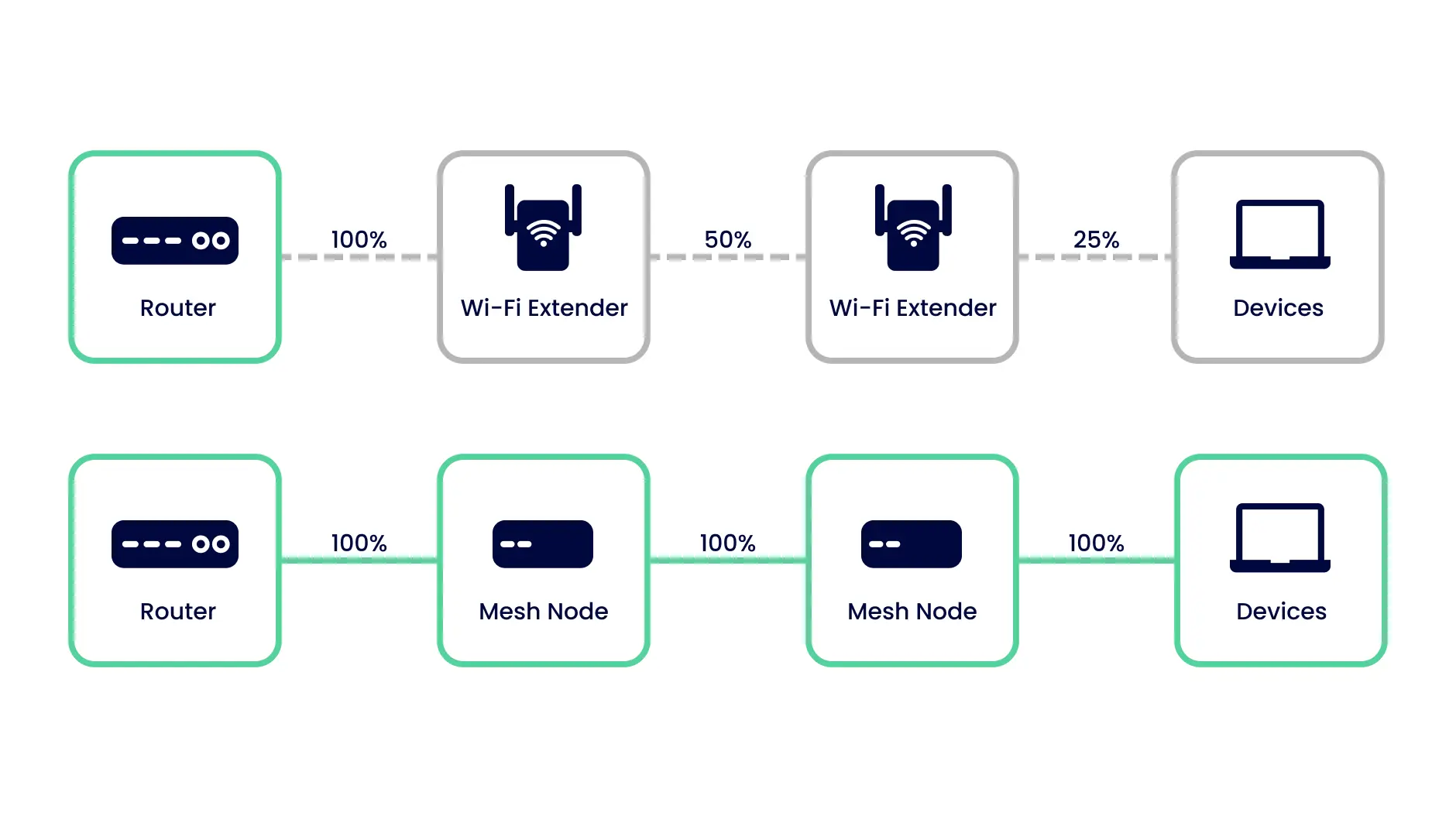
Tri-band WiFi extendersuse three separate bands to boost signal strength. This helps reduce interference and improves coverage range. Mesh systems use multiple nodes placed around the home to create a seamless network. This offers better coverageover a larger area.
Tri-band extenders provide good speeds but may experience higher latencydue to signal repeating. Mesh systems deliver faster speedsand lower latencybecause they use dedicated backhaul channels for communication.
| Tri-band WiFi Extender | Mesh System | |
|---|---|---|
| Signal Strength & Range | Boosts signal with three bands, good for medium homes | Multiple nodes cover large homes evenly |
| Speed & Latency | Good speed, some delay due to repeating | Higher speed, low delay with dedicated backhaul |
| Handling Multiple Devices | Handles several devices but can slow with many | Designed to support many devices with stable speeds |
Installation And Setup
Tri-band WiFi extendersusually have a quick setup. Most come with easy apps or WPS buttons. Users connect to the main router and extender fast. Mesh systemsoften ask for more steps. They use apps to guide users through setup. This can take longer but ensures better network design.
The user interfaceon mesh systems is often simpler. Apps let users see all devices and control settings in one place. Extenders may have basic web pages that are harder to use. Mesh systems update software automatically. Extenders might need manual updates.
| Feature | Tri-Band WiFi Extender | Mesh System |
|---|---|---|
| Setup | Fast, often with WPS or apps | Guided, takes longer |
| User Interface | Basic, web-based | Advanced app control |
| Compatibility | Works with most routers | Best with same brand routers |
Cost And Value Analysis
Tri Band Wifi Extendersusually cost less initially than mesh systems. They are simpler devices that plug into existing outlets. Mesh systems often require buying multiple units, raising the upfront price.
Long-term costs differ. Extenders may need frequent replacement or upgrades. Mesh systems offer more durable performance and easier updates. This can save money over time.
| Type | Initial Cost | Long-Term Cost | Value |
|---|---|---|---|
| Tri Band Wifi Extender | Lower | Moderate to High | Good for small areas |
| Mesh System | Higher | Lower over time | Better for larger homes |
Credit: inseego.com
Common Issues And Troubleshooting
Connectivity problemsoften arise from weak signals or device placement. Place extenders or mesh nodes closer to the main router. Avoid thick walls or metal objects that block signals. Restart devices to refresh connections. Check if too many devices connect at once, causing slow speeds or drops.
Interference and signal dropshappen due to other electronics or overlapping WiFi channels. Keep extenders and mesh nodes away from microwaves, cordless phones, and Bluetooth devices. Change the WiFi channel in your router settings to reduce interference. Use the 5 GHz band for less interference but shorter range.
Firmware and updateskeep your devices working smoothly. Check for updates regularly in the device’s app or website. Updates fix bugs and improve performance. Restart devices after updating to apply changes properly.
Choosing The Right Solution
Home size and layoutaffect which system fits best. Tri band extenders work well in medium homes with simple layouts. Mesh systems cover large or complex homes with many rooms and floors. Thick walls can block signals, so mesh nodes placed around the house keep WiFi strong everywhere.
Device density and usagealso matter. Tri band extenders handle fewer devices well, ideal for small families. Mesh systems support many devices and heavy use, perfect for homes with many users and smart gadgets.
Future growth is key. Mesh systems allow easy scalingby adding more nodes. Tri band extenders have limited range and fewer upgrade options.

Credit: www.which.co.uk

Credit: www.reddit.com
Frequently Asked Questions
What Is A Tri Band Wifi Extender?
A Tri Band Wifi Extender boosts your existing WiFi signal using three separate frequency bands. It enhances coverage and reduces congestion, ideal for larger homes. It connects to your main router and extends WiFi to dead zones, improving overall speed and reliability.
How Does A Mesh System Differ From Extenders?
A Mesh System uses multiple nodes working together to create a seamless WiFi network. Unlike extenders, it provides uniform coverage without signal drops. Mesh networks automatically route traffic efficiently, ensuring stable connections across large areas and multiple devices.
Which Is Better For Large Homes: Extender Or Mesh?
For large homes, Mesh Systems generally offer better coverage and consistent speeds. Extenders can cause signal loss and slower speeds when far from the router. Mesh Systems provide seamless roaming and stronger connections throughout all rooms.
Can Tri Band Extenders Reduce Wifi Congestion?
Yes, Tri Band Extenders reduce congestion by dedicating one band for router-extender communication. This setup frees up other bands for device connections, improving speed and reducing interference, especially in busy networks with many devices.
Conclusion
Choosing between a tri band WiFi extender and a mesh system depends on your needs. Extenders boost signal from your main router, good for small spaces. Mesh systems create a network with multiple nodes, ideal for larger homes. Both improve WiFi, but mesh offers smoother coverage.
Consider your home size, budget, and devices before deciding. Either way, better WiFi means fewer connection drops and faster speeds. Think about what fits your lifestyle best. Strong, steady internet helps everyone stay connected easily.